• úvod
  • témata
  • události
  • tržiště
  • diskuze
  • nástěnka
  • přihlásit
    registrace
    ztracené heslo?
    VIRGOCosmos In Brief - Aktualní novinky vesmírného výzkumu v kostce


    For every complex question, there's a simple answer that's completely wrong.
    rozbalit záhlaví
    DARKMOOR
    DARKMOOR --- ---
    NEBULA: Až o tolik blíž není a zas můžeš těžít z toho, že sondy mají víc energie ze solárních panelů, jak psala JULIANNE. Na papíře je i pár misí, které by do atmosféry Venuše umístily velké balóny. A jestli se nepletu, tak pár hodně odvážných počítalo i s balóny, které by nesly kromě automatických laboratoří i prostory pro lidi. Dost by to zjednodušilo průzkum povrchu, který tak trochu připomíná peklo.
    Povrchové vozítko by muselo mít vlastní samostatný zdroj energie, který by ho uživil na pár let. To by vyřešil radioizotopový generátor, který má momentálně největší problém v tom, že pro ně rychle dochází palivo a šetří s ním jak to jen jde. A pak by muselo přežít atmosferický tlak, který je cca 90x větší jak na zemi, teplotu přes 400°C a přeháňky tvořené kyselinou sírovou.
    Ale zas když už by něco takového v těchle podmínkách fungovalo pár let, tak už by to mohli nasadit skoro všude :)
    JULIANNE
    JULIANNE --- ---
    NEBULA: K Venuši se dostaneme rychleji než k Marsu a startovní okna jsou častější. Energie pro solární panely je víc než dost. Pro orbitery nebo atmosférické (třeba balonové) sondy je to super lokalita!
    Povrch už je samozřejmě něco jiného...
    VIRGO
    VIRGO --- ---
    NEBULA: Z dlouhodobého hlediska (obyvatelnosti) je jediná cesta dál od Slunce.
    Nestabilita se bude zhoršovat. Ale souhlasím s Darkmoorem, že její studium je důležité už kvůli tomu,
    aby to na Zemi neskončilo podobně co se týče klimatických podmínek.

    Dostávat se blíž ke Slunci je i náročnější, ale hlavně na povrchu Venuše probíhá mejdan,
    na kterém fakt nemáme co pohledávat.
    NEBULA
    NEBULA --- ---
    DARKMOOR: tak u venuše je ten "nezájem" snad daný tím, že je tak blízko slunci ne? tím myslím, že oproti marsu je asi dost problematické (nákladné) právě takový průzkum tam učinit? domnívám se.
    VIRGO
    VIRGO --- ---
    The LISA Mission proposal was submitted today!

    In response to the call of the European Space Agency (ESA) for L3 mission concepts,
    the LISA Mission consortium submitted the proposal for the Laser Interferometer Space Antenna today.

    The proposal document will be published in a few days on the LISA Mission homepage.

    LISA - mission concept proposal
    https://www.lisamission.org/consortium/

    VIRGO
    VIRGO --- ---
    No Launch for NASA's NEOCam Worries Asteroid Hunters - Seeker
    http://www.seeker.com/nasa-asteroid-space-telescope-b412-foundation-astronomy-2190478730.html

    The B612 Foundation reacts to NASA's decision not to fund a hazardous asteroid-hunting mission,
    urging the next administration to fund an infrared space telescope that would seek out near-Earth asteroid threats.

    VIRGO
    VIRGO --- ---
    Mystery Object in Cygnus A Galaxy - Sky & Telescope
    http://www.skyandtelescope.com/astronomy-news/mystery-object-in-cygnus-a-galaxy-1301201623/

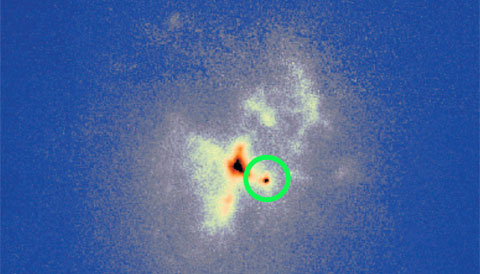
    Astronomers have discovered an object in the active galaxy Cygnus A that wasn’t there before.

    Last week at the American Astronomical Society meeting in Grapevine, Texas, astronomers made an announcement
    that’s caught the interest of several researchers: a very bright something has appeared in a well-known galaxy.

    That galaxy is the elliptical Cygnus A. Cygnus A is one of the brightest radio sources in the sky. It lies approximately 800 million
    light-years from us (redshift of 0.056). In its core sits a supermassive black hole madly eating and cocooned in gas, while two jets
    shoot out to either side and light up the intergalactic medium. This activity produces the radio radiation that makes Cygnus A so bright.

    Using the recently upgraded Karl G. Jansky Very Large Array (VLA) in New Mexico, Rick Perley (NRAO) and colleagues took a gander at Cygnus
    A — the first time the instrument has looked at the galaxy since 1989. (Apparently astronomers spent so much VLA time observing the galaxy
    in the 1980s that they didn’t feel the need to look again, Perley joked January 6th in his AAS presentation.) The new observations showed
    a surprise: a new, secondary object just southwest of the central black hole. This object wasn’t in the 1989 radio image. Additional, higher-
    resolution observations with the Very Long Baseline Array also picked up the object, clearly distinct from the galaxy’s nucleus. It’s roughly
    1,300 light-years from the center.

    The whatever-it-is is about twice as bright as the brightest known supernova at these frequencies. In fact, it’s much brighter than just about
    any transitory radio signal known, except for accreting supermassive black holes and tidal disruption events, outbursts created when a black
    hole eats a star.

    The team scoured other archives and found the object in 2003 Keck infrared observations and, more iffily, in some images from Hubble.
    (The object is so red that it doesn’t show up well at optical wavelengths, and in this range the space telescope’s resolution isn’t as
    good as that of Keck’s adaptive optics.)
    VIRGO
    VIRGO --- ---
    L3 magnet doors open, the ALICE experiment exposes its inner components to the (artificial) day light for the first time in years.
    In the center, the beam pipe. On the left, the low-beta platform (visitors view point). On top, the crane used to move material
    around the ALICE experimental area. The doors will be closed mid-April, in preparation for the 2017 beams.

    VIRGO
    VIRGO --- ---
    Twinkle, twinkle, little supernova | symmetry magazine
    http://www.symmetrymagazine.org/article/twinkle-twinkle-little-supernova

    Using Twinkles, the new simulation of images of our night sky, scientists get ready for a gigantic cosmological survey unlike any before.

    VIRGO
    VIRGO --- ---
    An Earth-Sized Telescope Is About to 'See' a Black Hole For the First Time | Motherboard
    http://motherboard.vice.com/...earth-sized-telescope-is-about-to-see-a-black-hole-for-the-first-time

    Designed by an international team led by MIT scientist Shep Doeleman, the EHT is the first of its kind-a global telescope network
    that uses a technique called interferometry to synthesize astronomical data from multiple sources, each with its own maser—including ALMA
    in Chile, the Large Millimeter Telescope atop the Sierra Negra volcano in Mexico, and the National Radio Astronomy Observatory in Virginia.

    Together, these telescopes create a super-telescope that is quite literally the size of the Earth, with enough resolution to photograph
    an orange on the Moon.

    With ALMA recently added to this Avengers-like team of radio telescopes, the network is ten times more sensitive. As a result, Doeleman’s
    group believes it has the firepower to penetrate the interstellar gases that cloak their targets: supermassive black holes. Drawn into orbit
    by the black holes’ gravity, these gases form gargantuan clouds that yield nothing to optical telescopes.

    Faint radio signals from the black holes, on the other hand, slip through the gas clouds and are ultimately detected on Earth.
    VIRGO
    VIRGO --- ---
    https://phys.org/news/2017-01-role-supermassive-black-holes-galaxies.html

    In roughly four billion years, the Milky Way will be no more.

    Indeed, our home galaxy is on course to collide and unite with the Andromeda Galaxy, at present some two million light years away.
    Of course, we don't notice that the two galaxies are drawing closer together. "To the human perspective, our galaxy doesn't appear
    to be changing," says University of Iowa astrophysicist Hai Fu, "but in the history of the universe, it is changing all the time."
    Galaxies have been merging for most of the universe's 13-billion-year history, and scientists have been observing these mergers for
    some time. What they don't fully understand is how mergers occur.

    Fu, an assistant professor in physics and astronomy, aims to clarify the phenomenon by observing supermassive black holes (with a mass
    of about one billion suns), which are at the center of most galaxies. Astrophysicists believe large galaxies grow by devouring smaller
    ones. In such cases, the black holes of both are expected to orbit each other and eventually merge. Fu and his team won a three-year,
    $405,011 grant from the National Science Foundation to find and characterize these celestial events.

    VIRGO
    VIRGO --- ---
    Fireball explodes near the Southern Cross over Puerto Rico, captured on January 12, 2017 by Frankie Lucena
    Fireball Explodes near Southern Cross
    https://www.youtube.com/watch?v=4KZmzPvkXzw
    VIRGO
    VIRGO --- ---
    EVA live:
    Proxima spacewalk live / Proxima / Human Spaceflight / Our Activities / ESA
    http://www.esa.int/Our_Activities/Human_Spaceflight/Proxima/Proxima_spacewalk_live

    NASA Television | NASA
    https://www.nasa.gov/multimedia/nasatv/#public
    VIRGO
    VIRGO --- ---
    Scientists: Moon over the hill at 4.51 billion years old (Update)
    http://phys.org/news/2017-01-scientists-moon-hill-billion-years.html

    It turns out the moon is older than many scientists suspected: a ripe 4.51 billion years old.

    That's the newest estimate, thanks to rocks and soil collected by the Apollo 14 moonwalkers in 1971.
    A research team reported Wednesday that the moon formed within 60 million years of the birth of the
    solar system. Previous estimates ranged within 100 million years, all the way out to 200 million
    years after the solar system's creation, not quite 4.6 billion years ago.

    VIRGO
    VIRGO --- ---
    Farthest Stars in Milky Way Might Be Ripped from Another Galaxy2017-02 | www.cfa.harvard.edu/
    https://www.cfa.harvard.edu/news/2017-02

    The 11 farthest known stars in our galaxy are located about 300,000 light-years from Earth, well outside the Milky Way's spiral disk.
    New research by Harvard astronomers shows that half of those stars might have been ripped from another galaxy: the Sagittarius dwarf.
    Moreover, they are members of a lengthy stream of stars extending one million light-years across space, or 10 times the width of our galaxy.

    "The star streams that have been mapped so far are like creeks compared to the giant river of stars we predict will be observed eventually,"
    says lead author Marion Dierickx of the Harvard-Smithsonian Center for Astrophysics (CfA).

    The Sagittarius dwarf is one of dozens of mini-galaxies that surround the Milky Way. Over the age of the universe it made several loops
    around our galaxy. On each passage, the Milky Way's gravitational tides tugged on the smaller galaxy, pulling it apart like taffy.

    VIRGO
    VIRGO --- ---
    Astronomers discover molecular and atomic clouds associated with a superbubble in LMC
    http://phys.org/news/2017-01-astronomers-molecular-atomic-clouds-superbubble.html

    An international team of astronomers has uncovered molecular and atomic gas clouds associated with the superbubble known as 30 Doradus C,
    which is located in the Large Magellanic Cloud (LMC). The findings were presented Jan. 8 on the arXiv pre-print repository.

    Called superbubble or supershell, 30 Doradus C is a bright X-ray cavity in the LMC with a diameter of approximately 300 light years. Although it
    was well studied at different wavelengths that revealed its shell-like morphology and the presence of six stellar clusters, the interstellar gas
    associated with this superbubble has not been thoroughly investigated yet.

    VIRGO
    VIRGO --- ---
    A simple explanation of mysterious space-stretching ‘dark energy?’ | Science | AAAS
    http://www.sciencemag.org/news/2017/01/simple-explanation-mysterious-space-stretching-dark-energy

    For nearly 2 decades, cosmologists have known that the expansion of the universe is accelerating, as if some mysterious "dark energy" is blowing
    it up like a balloon. Just what dark energy is remains one of the biggest mysteries in physics. Now, a trio of theorists argues that dark energy
    could spring from a surprising source. Weirdly, they say, dark energy could come about because—contrary to what you learned in your high school
    physics class—the total amount of energy in the universe isn't fixed, or "conserved," but may gradually disappear.

    "It's a great direction to explore," says George Ellis, a theorist at the University of Cape Town in South Africa, who was not involved in the work.
    But Antonio Padilla, a theorist at the University of Nottingham in the United Kingdom, says, "I don't necessarily buy what they've done."
    VIRGO
    VIRGO --- ---
    VIRGO
    VIRGO --- ---
    Simulations suggest Planet Nine may have been a rogue
    http://phys.org/news/2017-01-simulations-planet-rogue.html

    Space researchers James Vesper and Paul Mason with New Mexico State University have given a presentation at this year's American Astronomical
    Science meeting outlining the results of simulations they have been running to learn more about Planet Nine—a planet that many in the space
    science community believe exists far beyond Pluto. They presented evidence suggesting that if Planet Nine is out there, it is likely a rogue.
    VIRGO
    VIRGO --- ---
    "Do you know what the Milky Way is?"
    Exploring space through a vintage cigarette card, courtesy of NY Public Library.

    VIRGO
    VIRGO --- ---
    11-year-old Astronomer Shines at AAS Meeting - Sky & Telescope
    http://www.skyandtelescope.com/astronomy-news/adolescent-astronomers-shine-at-aas-meeting/
    Cannan Huey-You, just 11 years old, impressed professional astronomers this week with his research on a massive intergalactic gas cloud.

    VIRGO
    VIRGO --- ---
    Neptune as a Mirror for the Sun
    http://aasnova.org/2017/01/11/neptune-as-a-mirror-for-the-sun/

    How would the Kepler mission see a star like the Sun? We now know the answer to this question due to a creative approach:
    a new study has used the Kepler K2 mission to detect signals from the Sun reflected off of the surface of Neptune.

    VIRGO
    VIRGO --- ---
    One Dozen and One Neutron Stars | Max Planck Institute for Gravitational Physics (Albert Einstein Institute)
    http://www.aei.mpg.de/1997338/13fgrps
    With the help of tens of thousands of volunteers the distributed computing project Einstein@Home discovers 13 new gamma-ray pulsars

    VIRGO
    VIRGO --- ---
    (update)
    UCLA Galactic Center Group
    http://www.galacticcenter.astro.ucla.edu/animations.html

    Animation of the Stellar Orbits around the Galactic Center
    https://www.youtube.com/watch?v=AZhUQl-wmq0
    VIRGO
    VIRGO --- ---
    Hidden Figures: Triumphant in the theater, sobering after | The Planetary Society
    http://www.planetary.org/blogs/emily-lakdawalla/2017/01101432-hidden-figures.html

    Hidden Figures | Teaser Trailer [HD] | 20th Century FOX
    https://www.youtube.com/watch?v=RK8xHq6dfAo
    VIRGO
    VIRGO --- ---
    Looking for life in all the right places -- with the right tool | EurekAlert! Science News
    https://www.eurekalert.org/pub_releases/2017-01/acs-lfl011117.php
    DARKMOOR
    DARKMOOR --- ---
    VIRGO: Je škoda, že se Venuši věnuje tak málo pozornosti. Vzhledem k podobnosti se Zemí, bych čekal větší zájem. Bylo by fajn dostat na povrch pár vozítek a provést podobný průzkum jako na Marsu. Celkem by mě zajímalo jestli by se povedlo aspoň náznakem zjisit, co se s Venuší stalo, že má tak divnou rotaci a atmosféru. Jestli ji někdy v minulosti trefilo něco hodně velkého nebo k tomu pomohly rozsáhle erupce magmatu, které zahustily atmosféru, nastartovaly skleníkový efekt a všechno šlo do kytek...
    VIRGO
    VIRGO --- ---
    New Comet: C/2017 A3 (Elenin)
    Remanzacco Observatory - Comets & Neo: New Comet: C/2017 A3 (Elenin)
    http://remanzacco.blogspot.cz/2017/01/new-comet-c2017-a3-elenin.html

    VIRGO
    VIRGO --- ---
    Photons struggle to escape distant galaxies
    http://www.ras.org.uk/...truggle-to-escape-distant-galaxies-creates-giant-halos-of-scattered-photons

    Astronomers led by David Sobral and Jorryt Matthee, of the Universities of Lancaster in the UK and Leiden in the Netherlands, have discovered giant halos
    around early Milky Way type galaxies, made of photons (elementary particles of light) that have struggled to escape them. The team reports its findings
    in the journal Monthly Notices of the Royal Astronomical Society.

    In order to understand how our own Milky Way galaxy formed and evolved, astronomers rely on observing distant galaxies. As their light takes billions of
    years to reach us, telescopes can be used as time machines, as long as we have a clear indicator to pinpoint the distance to the objects being observed.
    As with closer galaxies, stars and planets, astronomers use the technique of spectroscopy to analyse their light, dispersing it into a spectrum.

    Scientists then look for characteristic features (spectral lines) that tell them about properties including the composition, temperature and movement of
    the object. With the most distant galaxies, only one spectral feature typically stands out, the so-called Lyman-alpha line associated with hydrogen gas.

    VIRGO
    VIRGO --- ---
    Very interesting rock structures, probably fallen blocks of sedimentary lakebed mudstones, as seen by Curio Right Mastcam (M-100) during Sol 1574 (Jan.9)

    VIRGO
    VIRGO --- ---
    [1701.02534] Visible spectra of (474640) 2004 VN112-2013 RF98 with OSIRIS at the 10.4 m GTC: evidence for binary dissociation near aphelion among the extreme trans-Neptunian objects
    https://arxiv.org/abs/1701.02534

    A new scientific paper reports on the spectra via a large telescope in the Canary Islands of some of the Extreme Trans-Neptunian
    Objects (ETNO's) referred to in a number of Planet Nine science papers. Some of these ETNO's appear to have a common origin and
    two of them seem to have originally been part of a binary asteroid that was disrupted by a massive Planet Nine-like object.
    VIRGO
    VIRGO --- ---
    Cosmos on Nautilus: The Not-So-Fine Tuning of the Universe
    http://cosmos.nautil.us/feature/113/the-not-so-fine-tuning-of-the-universe
    There’s more than one way to build a universe suitable for life.

    Before there is life, there must be structure. Our universe synthesized atomic nuclei early in its history. Those nuclei ensnared electrons to form atoms.
    Those atoms agglomerated into galaxies, stars, and planets. At last, living things had places to call home. We take it for granted that the laws of physics
    allow for the formation of such structures, but that needn’t have been the case.

    Over the past several decades, many scientists have argued that, had the laws of physics been even slightly different, the cosmos would have been devoid of
    complex structures. In parallel, cosmologists have come to realize that our universe may be only one component of the multiverse, a vast collection of universes
    that makes up a much larger region of spacetime. The existence of other universes provides an appealing explanation for the apparent fine-tuning of the laws of
    physics. These laws vary from universe to universe, and we live in a universe that allows for observers because we couldn’t live anywhere else.

    Astrophysicists have discussed fine-tuning so much that many people take it as a given that our universe is preternaturally fit for complex structures. Even
    skeptics of the multiverse accept fine-tuning; they simply think it must have some other explanation. But in fact the fine-tuning has never been rigorously
    demonstrated. We do not really know what laws of physics are necessary for the development of astrophysical structures, which are in turn necessary for the
    development of life. Recent work on stellar evolution, nuclear astrophysics, and structure formation suggest that the case for fine-tuning is less compelling
    than previously thought. A wide variety of possible universes could support life. Our universe is not as special as it might seem.

    VIRGO
    VIRGO --- ---
    A Too-Hot Pulsar Speeding Through the Galaxy | astrobites
    https://astrobites.org/2017/01/10/a-too-hot-pulsar-speeding-through-the-galaxy/
    Hubble Space Telescope detection of the millisecond pulsar J2124-3358 and its far-ultraviolet bow shock nebula

    Pulsars — the rapidly rotating, highly magnetized neutron stars that beam radiation from their magnetic axes — are as mysterious as they are exotic.
    They’re most often observed at radio frequencies using single-dish telescopes, and are sometimes glimpsed in X-ray and gamma-ray bands. Far rarer
    are pulsar observations at “in-between” frequencies, such as ultraviolet (UV), optical, and infrared (IR) (collectively, UVOIR); in fact, only about
    a dozen pulsars have been detected this way. However, their study in this frequency range has proved enlightening, as we will see in today’s post.

    A pulsar too hot to handle

    While one would expect a neutron star to cool with age if an internal heating mechanism does not operate throughout its lifetime, observations of
    the millisecond pulsar J0437–4715 (an interesting object in its own right) yielded surprising results. In a 2016 study, far-UV observations revealed
    the 7-billion-year-old pulsar to have a surface temperature of about 2 × 10⁵ K — about 35 times the temperature of the Sun’s photosphere. This
    finding inspired Rangelov et al. to observe another millisecond pulsar, J2124-3358 (a 3.8-billion-year-old pulsar with a spin period of 4.93 ms), in
    the far-UV and optical bands using the Hubble Space Telescope (HST).

    Kliknutím sem můžete změnit nastavení reklam