• úvod
  • témata
  • události
  • tržiště
  • diskuze
  • nástěnka
  • přihlásit
    registrace
    ztracené heslo?
    VIRGOCosmos In Brief - Aktualní novinky vesmírného výzkumu v kostce
    VIRGO
    VIRGO --- ---
    Distant galaxy group contradicts common cosmological models, simulations
    https://news.uci.edu/.../01/distant-galaxy-group-contradicts-common-cosmological-models-simulations/

    An international team of astronomers has determined that Centaurus A, a massive elliptical galaxy 13 million light-years from Earth,
    is accompanied by a number of dwarf satellite galaxies orbiting the main body in a narrow disk. In a paper published today in Science,
    the researchers note that this is the first time such a galactic arrangement has been observed outside the Local Group, home to the Milky Way.

    VINCENT_BU
    VINCENT_BU --- ---
    nový popularizující dokument
    Black Hole Apocalypse 2018 HD DOCUMENTARY
    https://www.youtube.com/watch?v=TqKsV9FyV_c
    VIRGO
    VIRGO --- ---
    Oujééé!! :)

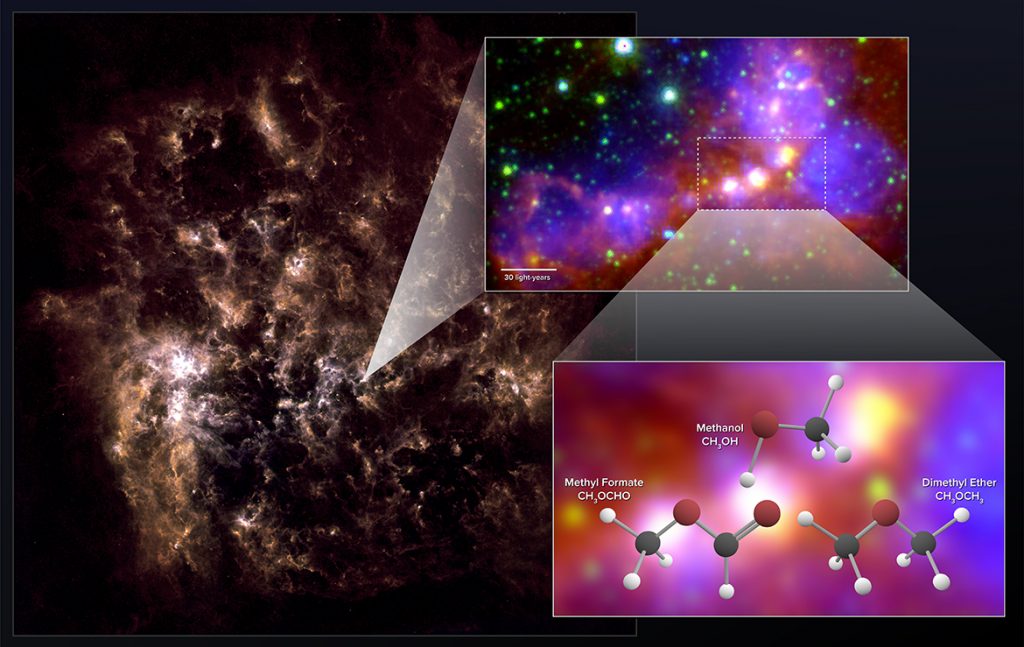
    Stellar Embryos in Nearby Dwarf Galaxy Contain Surprisingly Complex Organic Molecules - National Radio Astronomy Observatory
    https://public.nrao.edu/news/2018-alma-coms-lmc/

    The nearby dwarf galaxy known as the Large Magellanic Cloud (LMC) is a chemically primitive place.

    Unlike the Milky Way, this semi-spiral collection of a few tens-of-billions of stars lacks our galaxy’s rich abundance of heavy elements, like carbon, oxygen, and nitrogen. With such a dearth
    of heavy elements, astronomers predict that the LMC should contain a comparatively paltry amount of complex carbon-based molecules. Previous observations of the LMC seem to support that view.

    New observations with the Atacama Large Millimeter/submillimeter Array (ALMA), however, have uncovered the surprisingly clear chemical “fingerprints” of the complex organic molecules methanol,
    dimethyl ether, and methyl formate. Though previous observations found hints of methanol in the LMC, the latter two are unprecedented findings and stand as the most complex molecules ever
    conclusively detected outside of our galaxy.

    Astronomers discovered the molecules’ faint millimeter-wavelength “glow” emanating from two dense star-forming embryos in the LMC, regions known as “hot cores.” These observations may provide
    insights into the formation of similarly complex organic molecules early in the history of the universe.

    “Even though the Large Magellanic Cloud is one of our nearest galactic companions, we expect it should share some uncanny chemical similarity with distant, young galaxies from the early universe,”
    said Marta Sewiło, an astronomer with NASA’s Goddard Space Flight Center in Greenbelt, Maryland, and lead author on a paper appearing in the Astrophysical Journal Letters.
    VIRGO
    VIRGO --- ---
    Newborns or survivors? The unexpected matter found in hostile black hole winds - Northwestern Now
    https://news.northwestern.edu/...-survivors-the-unexpected-matter-found-in-hostile-black-hole-winds/

    The existence of large numbers of molecules in winds powered by supermassive black holes at the centers of galaxies has puzzled astronomers since they were discovered more than a decade ago.
    Molecules trace the coldest parts of space, and black holes are the most energetic phenomena in the universe, so finding molecules in black hole winds was like discovering ice in a furnace.

    Astronomers questioned how anything could survive the heat of the energetic outflows, but a new theory from researchers in Northwestern University’s Center for Interdisciplinary Research and
    Exploration in Astrophysics (CIERA) predicts that these molecules are not survivors at all, but brand-new molecules, born in the winds with unique properties that enable them to adapt to and
    thrive in the hostile environment.

    The theory, published in the Monthly Notices of the Royal Astronomical Society, is the work of Lindheimer post-doctoral fellow Alexander Richings, who developed the computer code that,
    for the first time, modeled the detailed chemical processes that occur in interstellar gas accelerated by radiation emitted during the growth of supermassive black holes.

    VIRGO
    VIRGO --- ---
    Interstellar Fullerenes May Help Find Solutions for Earthly Matters
    https://kpfu.ru/eng/news-eng/interstellar-fullerenes.html

    A group of astronomers is currently engaged in studies of fullerenes in interstellar medium. Among them are KFU alumni Gazinur Galazutdinov (Catholic University of
    the North, Chile) and Gennady Valyavin (Special Astrophysical Observatory of the Russian Academy of Sciences) and current KFU employee, Associate Professor at the
    Department of Astronomy and Space Geodesy Vladislav Shimansky. Together, they contributed to a recent paper in Monthly Notices of the Royal Astronomical Society.

    The nearest interstellar clouds with confirmed fullerene presence are about 1,000 light years away from Earth. Electromagnetic spectra of 19 distant stars were
    provided by the VLT telescope in Chile, one of the largest in the world. The authors found fullerenes which left traces – absorption lines in certain frequencies.

    VIRGO
    VIRGO --- ---
    Impressive rocket re-entry over South America, large fragment found in Peru
    https://watchers.news/...impressive-rocket-re-entry-over-south-america-large-fragment-found-in-peru/

    Residents of eastern Brazil and northern Peru witnessed a rare atmospheric re-entry of a recently launched rocket that ended up hard landing in pieces
    over South America. The rocket was launched from Baikonur Cosmodrome in Kazakhstan on December 26, 2017, carrying AngoSat 1 Communications Satellite.

    Reentrada de lixo espacial no Acre, Rondônia e Peru parte 2 - imagens do fragmentos encontrados
    https://www.youtube.com/watch?time_continue=15&v=llxoArXZpmY
    VIRGO
    VIRGO --- ---
    James Webb Space Telescope’s Multifaceted MIRI
    https://www.youtube.com/watch?v=PYIfmAbkk4k
    VIRGO
    VIRGO --- ---
    https://www.nasa.gov/feature/super-blue-blood-moon-coming-jan-31

    Beginning at 5:30 a.m. EST on Jan. 31, a live feed of the Moon will be offered on NASA TV and NASA.gov/live. You can also follow at @NASAMoon.
    Weather permitting, the NASA TV broadcast will feature views from the varying vantage points of telescopes at NASA’s Armstrong Flight Research
    Center in Edwards, California; Griffith Observatory in Los Angeles; and the University of Arizona’s Mt. Lemmon SkyCenter Observatory.

    VIRGO
    VIRGO --- ---
    Astrochemists reveal the magnetic secrets of methanol | Chalmers
    https://www.chalmers.se/...oso/news/Pages/Astrochemists-reveal-the-magnetic-secrets-of-methanol.aspx

    ​A team of scientists, led by Boy Lankhaar at Chalmers University of Technology, has solved an important puzzle in astrochemistry: how to measure magnetic fields in space
    using methanol, the simplest form of alcohol. Their results, published in the journal Nature Astronomy, give astronomers a new way of investigating how massive stars are born.

    ​Over the last half-century, many molecules have been discovered in space. Using radio telescopes, astronomers have with the help of these molecules been able to investigate just
    what happens in the dark and dense clouds where new stars and planets are born.

    Scientists can measure temperature, pressure and gas motions when they study the signature of molecules in the signals they detect. But especially where the most massive stars
    are born, there’s another major player that’s more difficult to measure: magnetic fields.

    VIRGO
    VIRGO --- ---
    Space in Images - 2018 - 01 - Obscured Sirius reveals Gaia 1 cluster
    http://www.esa.int/spaceinimages/Images/2018/01/Obscured_Sirius_reveals_Gaia_1_cluster

    Dazzling stars like Sirius are both a blessing and a curse for astronomers. Their bright appearance provides plenty of light
    to study their properties, but also outshines other celestial sources that happen to lie in the same patch of sky.

    This is why Sirius has been masked in this picture taken by amateur astronomer Harald Kaiser on 10 January from Karlsruhe,
    a city in the southwest of Germany.

    Once the glare of Sirius is removed, an interesting object becomes visible to its left: the stellar cluster Gaia 1, first
    spotted last year using data from ESA’s Gaia satellite.

    Gaia 1 is an open cluster – a family of stars all born at the same time and held together by gravity – and it is located
    some 15 000 light-years away. Its chance alignment next to nearby, bright Sirius kept it hidden to generations of astronomers
    that have been sweeping the heavens with their telescopes over the past four centuries. But not to the inquisitive eye of Gaia,
    which has been charting more than a billion stars in our Milky Way galaxy.

    IoW_20180129 - Cosmos
    https://www.cosmos.esa.int/web/gaia/iow_20180129

    VIRGO
    VIRGO --- ---
    What would it have been like to witness the beginning of the universe?
    https://theconversation.com/...ould-it-have-been-like-to-witness-the-beginning-of-the-universe-90043

    In the Big Bang, space was suffused with light. A fraction of a second after the event, the universe was over a million trillion
    times smaller than an atom. It was also hot: a septillion (one followed by 24 zeroes) times hotter than the centre of the sun.

    From this small and hot beginning, the expansion and cooling started. In this early stage, the universe was extremely bright and
    at frequencies of light that humans cannot see. There were no stars, only a uniform and formless soup of particles. In opening your
    eyes to the night sky – if such a thing were possible in the moment before you burned up – you would have been instantly blinded by
    the intensity of the light (even light outside visible frequencies can harm our eyes).

    [1801.03278] How Bright Was the Big Bang?
    https://arxiv.org/abs/1801.03278

    VIRGO
    VIRGO --- ---
    2018 | University of Canterbury
    http://www.canterbury.ac.nz/...ws-first-jet-from-massive-young-star-detected-outside-our-galaxy.html

    In a significant astronomical discovery, a University of Canterbury scientist has made the very first detection of a jet from a very young, massive star in a galaxy that is not our own.

    Dr McLeod is the lead author of the new article about the discovery “A parsec-scale optical jet from a massive young star in the Large Magellanic Cloud”, co-authored with researchers
    in Germany, the United Kingdom and the United States, which has been published today in Nature, one of the highest-impact scientific journals.

    The researchers say the jet spans about 36 light years (or 11 parsecs), which makes it among the largest jets of its kind ever found. The star powering the jet appears to be about
    12 times as massive as our Sun. The data used for this work comes from the Very Large Telescope (VLT) in Chile’s Atacama Desert, which is among the largest optical telescopes in
    the world and is one of the most competitive telescopes on which to obtain precious observing time.

    VIRGO
    VIRGO --- ---
    Where are You Going in 2018 (Cosmically Speaking)? - Out There
    http://blogs.discovermagazine.com/outthere/2018/01/24/going-2018-cosmically-speaking/#.WmnVZPmnFhE

    How to answer the question Where are you going? depends entirely your reference frame. There is no master set of coordinates for the universe (thanks a lot, Einstein),
    so you can only answer the question by addressing the subordinate question, In relation to what? Fortunately, that’s exactly when things start to get interesting.

    Astronomy textbooks typically depict our motion through space in terms of vector arrows pointing in different directions, indicating the direction of Earth’s orbit
    around the Sun and the like. A recent question on Quora got me thinking about things a different way, however. What if you were suddenly motionless relative to the
    various cosmic reference frames about you? What would you see and experience if you made yourself the center of the universe, and let everything else move around you?

    VIRGO
    VIRGO --- ---
    Europa and Other Planetary Bodies May Have Extremely Low-Density Surfaces | Planetary Science Institute
    http://www.psi.edu/news/press-releases

    Spacecraft landing on Jupiter’s moon Europa could see the craft sink due to high surface porosity, research by Planetary Science Institute Senior Scientist Robert Nelson shows.

    Nelson was the lead author of a laboratory study of the photopolarimetric properties of bright particles that explain unusual negative polarization behavior at low phase angles
    observed for decades in association with atmosphereless bodies including asteroids 44 Nysa, 64 Angelina and the Galilean satellites Io, Europa and Ganymede.

    These observations are explained by extremely fine-grained particles with void space greater than about 95 percent. Grain sizes would be on the order of the wavelength of light
    of the observations (a fraction of a micron). This corresponds to material that would be less dense than freshly fallen snow, raising questions about the risk of a Europa lander
    sinking into the surface of the Jupiter satellite.

    This work was published in the journal Icarus and is titled "Laboratory simulations of planetary surfaces: Understanding regolith physical properties from remote photopolarimetric
    observations."

    Observations were made using a goniometric photopolarimeter of novel design located at Mt. San Antonio College in Walnut, California. The powders used were aluminum oxide
    (Al2O3), which is an excellent regolith analog for high albedo airless bodies in the solar system, including water ice bodies such as Europa.

    VIRGO
    VIRGO --- ---
    SpaceX - Falcon Heavy - Wet Load All Boosters 01-20-2018
    https://www.youtube.com/watch?v=pdcDI98RSgo
    VIRGO
    VIRGO --- ---
    Forming Stars Near Our Supermassive Black Hole
    http://aasnova.org/2018/01/24/forming-stars-near-our-supermassive-black-hole/

    Around Sgr A*, the supermassive black hole lurking at the Milky Way’s center, lies a population of ~200 massive, young, bright stars. Their very tight orbits around
    the black hole pose a mystery: did these intrepid stars somehow manage to form in situ, or did they instead migrate to their current locations from further out?

    For a star to be born out of a molecular cloud, the self-gravity of the cloud clump must be stronger than the other forces it’s subject to. Close to a supermassive
    black hole, the brutal tidal forces of the black hole dominate over all else. For this reason, it was thought that stars couldn’t form in the hostile environment
    near a supermassive black hole — until clues came along suggesting otherwise.

    VIRGO
    VIRGO --- ---
    BETTER: Parááda! Tohle video e lepší než to odpoledmí. :)
    VIRGO
    VIRGO --- ---
    Scientists fine-tune formula for finding signs of life in alien air – GeekWire
    https://www.geekwire.com/2018/scientists-fine-tune-formula-finding-signs-life-alien-atmospheres/

    If we detect oxygen in the atmosphere of an alien world, does that mean life is present? Not necessarily:
    Scientists say the chemical signature of biological activity is likely to be more subtle, involving a mix of gases that might seem out of whack.

    In a paper published today in Science Advances, researchers say future observatories such as NASA’s James Webb Space Telescope should look for
    the signature of atmospheric gases that would be in disequilibrium if it weren’t for biological processes.

    NASA | Alien Atmospheres
    https://www.youtube.com/watch?v=CcUhVCMAhAI


    The study’s lead author, Joshua Krissansen-Totton of the University of Washington, says looking for oxygen alone shouldn’t be the sole strategy
    in the search for life on extrasolar planets.

    “This idea of looking for atmospheric oxygen as a biosignature has been around for a long time. And it’s a good strategy — it’s very hard to make
    much oxygen without life,” he said in a news release. “But we don’t want to put all our eggs in one basket. Even if life is common in the cosmos,
    we have no idea if it will be life that makes oxygen. The biochemistry of oxygen production is very complex and could be quite rare.”

    He and his colleagues propose an alternative chemical formula to look for: methane plus carbon dioxide, minus carbon monoxide.

    VIRGO
    VIRGO --- ---
    European-Russian space mission steps up the search for life on Mars | EurekAlert! Science News
    https://www.eurekalert.org/pub_releases/2018-01/miop-esm012418.php

    The ExoMars joint space mission of ESA and Roscosmos involves two phases. The first one started on March 14, 2016,
    with the launch of a Proton-M booster rocket from Russia's space complex in Baikonur, Kazakhstan. The rocket launched two modules:
    the Schiaparelli lander and the Trace Gas Orbiter (TGO). The two were delivered to Mars in 226 days, making a journey of 500 million kilometers.

    VIRGO
    VIRGO --- ---
    SpaceX fires engines on big new rocket in launch pad test
    https://phys.org/news/2018-01-spacex-big-rocket-pad.html

    SpaceX fired up its newest, biggest rocket in a critical launch pad test Wednesday, advancing toward a long-anticipated test flight possibly in just a week.

    VIRGO
    VIRGO --- ---
    Curio MAHLI selfie on the South Rim of Vera Rubin Ridge, Sol 1940 (23/01/18). Credits: NASA/JPL-CalTech/MSSS. Processed by Paul Hammond

    VIRGO
    VIRGO --- ---
    JULIANNE: Čupr! :)
    JULIANNE
    JULIANNE --- ---
    VIRGO: Vida, to už vyšlo! Vera Dobos byla na Geosciences for Understanding Planetary Habitability in The Solar System and Beyond, and Lena Noack se jí celkem případně ptala na to, jestli plánuje zahrnout indukční ohřev, já snad na to, jestli přibudou slapové interakce mezi planetami, nejen hvězda-planeta, a Tomáš Petrásek na atmosférický feedback. Třeba už tam všechno je, jdu se mrknout :).
    VIRGO
    VIRGO --- ---
    TRAPPIST-1 System Planets Potentially Habitable | Planetary Science Institute
    http://www.psi.edu/news/press-releases

    Two exoplanets in the TRAPPIST-1 system have been identified as most likely to be habitable, a paper by PSI Senior Scientist Amy Barr says.

    The TRAPPIST-1 system has been of great interest to observers and planetary scientists because it seems to contain seven planets that are all roughly Earth-sized,
    Barr and co-authors Vera Dobos and Laszlo L. Kiss said in “Interior Structures and Tidal Heating in the TRAPPIST-1 Planets” that appears in Astronomy & Astrophysics.

    “Because the TRAPPIST-1 star is very old and dim, the surfaces of the planets have relatively cool temperatures by planetary standards, ranging from 400 degrees Kelvin
    (260 degrees Fahrenheit), which is cooler than Venus, to 167 degrees Kelvin (-159 degrees Fahrenheit), which is colder than Earth’s poles,” Barr said. “The planets also
    orbit very close to the star, with orbital periods of a few days. Because their orbits are eccentric –not quite circular – these planets could experience tidal heating
    just like the moons of Jupiter and Saturn.”

    “Assuming the planets are composed of water ice, rock, and iron, we determine how much of each might be present, and how thick the different layers would be. Because
    the masses and radii of the planets are not very well-constrained, we show the full range of possible interior structures and interior compositions.” Barr said. The team’s
    results show that improved estimates of the masses of each planet can help determine whether each of the planets has a significant amount of water.

    The planets studied are referred to by letter, planets b through h, in order of their distance from the star. Analyses performed by co-author Vera Dobos show that planets
    d and e are the most likely to be habitable due to their moderate surface temperatures, modest amounts of tidal heating, and because their heat fluxes are low enough to
    avoid entering a runaway greenhouse state. A global water ocean likely covers planet d.

    The team calculated the balance between tidal heating and heat transport by convection in the mantles of each planet. Results show that planets b and c likely have
    partially molten rock mantles. The paper also shows that planet c likely has a solid rock surface, and could have eruptions of silicate magmas on its surface driven
    by tidal heating, similar to Jupiter’s moon Io.

    VIRGO
    VIRGO --- ---
    Dust storms linked to gas escape from Martian atmosphere | CU Boulder Today | University of Colorado Boulder
    https://www.colorado.edu/today/2018/01/22/dust-storms-linked-gas-escape-martian-atmosphere

    Some Mars experts are eager and optimistic for a dust storm this year to grow so grand it darkens skies around the entire Red Planet.
    This type of phenomenon in the environment of modern Mars could be examined as never before possible, using the combination of spacecraft now at Mars.

    A study published today and co-authored by CU Boulder scientists looked at observations by NASA's Mars Reconnaissance Orbiter (MRO) during the most recent
    Martian global dust storm. That 2007 event suggests such storms play a role in the ongoing process of gas escaping from the top of Mars' atmosphere,
    a process which long ago transformed wetter, warmer ancient Mars into today's arid, frozen planet.

    "We found there's an increase in water vapor in the middle atmosphere in connection with dust storms," said Nicholas Heavens of Hampton University,
    Hampton, Virginia, lead author of the report in Nature Astronomy. "Water vapor is carried up with the same air mass rising with the dust."

    VIRGO
    VIRGO --- ---
    Johns Hopkins Scientist Proposes New Definition of a Planet « News from The Johns Hopkins University
    http://releases.jhu.edu/2018/01/22/johns-hopkins-scientist-proposes-new-definition-of-a-planet/

    Pluto hogs the spotlight in the continuing scientific debate over what is and what is not a planet, but a less conspicuous argument rages on about the planetary
    status of massive objects outside our solar system. The dispute is not just about semantics, as it is closely related to how giant planets like Jupiter form.

    Johns Hopkins University astrophysicist Kevin Schlaufman aims to settle the dispute.

    In a paper just published in the Astrophysical Journal, Schlaufman has set the upper boundary of planet mass between four and 10 times the mass of the planet Jupiter.

    [1801.06185] Evidence of an Upper Bound on the Masses of Planets and its Implications for Giant Planet Formation
    https://arxiv.org/abs/1801.06185

    Schlaufman, an assistant professor in the university’s Department of Physics & Astronomy, says setting a limit is possible now mainly due to improvements in the technology
    and techniques of astronomical observation. The advancements have made it possible to discover many more planetary systems outside our solar system and therefore possible
    to see robust patterns that lead to new revelations.

    “While we think we know how planets form in a big picture sense, there’s still a lot of detail we need to fill in,” Schlaufman said. “An upper boundary on the masses of
    planets is one of the most prominent details that was missing.”

    The conclusions in the new paper are based on observations of 146 solar systems, systems, Schlaufman said, is the fact that almost all the data he used was measured in
    a uniform way. The data are more consistent from one solar system to the next, and so more reliable.

    Defining a planet, distinguishing it from other celestial objects, is a bit like narrowing down a list of criminal suspects. It’s one thing to know you’re looking for
    someone who is taller than 5-foot-8, it’s another to know your suspect is between 5-foot-8 and 5-foot-10.

    In this instance, investigators want to distinguish between two suspects: a giant planet and a celestial object called a brown dwarf. Brown dwarfs are more massive than
    planets, but less massive than the smallest stars. They are thought to form as stars do.

    For decades brown dwarfs have posed a problem for scientists: how to distinguish low-mass brown dwarfs from especially massive planets? Mass alone isn’t enough to tell
    the difference bzween the two, Schlaufman said. Some other property was needed to draw the line.

    In Schlaufman’s new argument, the missing property is the chemical makeup of a solar system’s own sun. He says you can know your suspect, a planet, not just by his size,
    but also by the company he keeps. Giant planets such as Jupiter are almost always found orbiting stars that have more iron than our sun. Brown dwarfs are not so discriminating.
    VIRGO
    VIRGO --- ---
    Featured Image: New Detail in the Toothbrush Cluster
    http://aasnova.org/2018/01/22/featured-image-new-detail-in-the-toothbrush-cluster/

    This spectacular composite reveals the galaxy cluster 1RXS J0603.3+4214, known as the “Toothbrush cluster” due to the shape of its most prominent radio relic. Featured in a recent publication led by Kamlesh Rajpurohit
    (Thuringian State Observatory, Germany), this image contains new Very Large Array (VLA) 1.5-GHz observations (red) showing the radio emission within the cluster. This is composited with a Chandra view of the X-ray emitting
    gas of the cluster (blue) and an optical image of the background from Subaru data. The new deep VLA data — totaling 26 hours of observations — provides a detailed look at the complex structure within the Toothbrush relic,
    revealing enigmatic filaments and twists (see below). This new data will help us to explore the possible merger history of this cluster, which is theorized to have caused the unusual shapes we see today.

    VIRGO
    VIRGO --- ---
    Scientists find evidence of strong winds outside black holes
    https://www.folio.ca/scientists-find-evidence-of-strong-winds-outside-black-holes/

    New research shows the first evidence of strong winds around black holes throughout bright outburst events in which black holes rapidly consume mass.

    The study sheds new light on how mass transfers to black holes and how they can affect the environment around them.

    “Winds must blow away a large fraction of the matter a black hole could eat,’’ said Bailey Tetarenko, a University of Alberta PhD student and lead author
    on the study. “In one of our models, the winds removed 80 per cent of the black hole’s potential meal.”

    The research was conducted by an international team of researchers, led by Tetarenko and scientists in the U of A's Department of Physics.
    VIRGO
    VIRGO --- ---
    A ‘hot Jupiter’ with unusual winds | Newsroom - McGill University
    http://www.mcgill.ca/newsroom/channels/news/hot-jupiter-unusual-winds-284028

    The hottest point on a gaseous planet near a distant star isn’t where astrophysicists expected it to be –
    a discovery that challenges scientists’ understanding of the many planets of this type found in solar systems outside our own.

    Unlike our familiar planet Jupiter, so-called hot Jupiters circle astonishingly close to their host star -- so close that it typically takes fewer than three days to complete an orbit.
    And one hemisphere of these planets always faces its host star, while the other faces permanently out into the dark. Not surprisingly, the “day” side of the planets gets vastly hotter
    than the night side, and the hottest point of all tends to be the spot closest to the star. Astrophysicists theorize and observe that these planets also experience strong winds blowing
    eastward near their equators, which can sometimes displace the hot spot toward the east.

    In the mysterious case of exoplanet CoRoT-2b, however, the hot spot turns out to lie in the opposite direction: west of center. A research team led by astronomers at McGill University’s
    McGill Space Institute (MSI) and the Institute for research on exoplanets (iREx) in Montreal made the discovery using NASA’s Spitzer Space Telescope. Their findings are reported Jan. 22
    in the journal Nature Astronomy.

    VIRGO
    VIRGO --- ---
    A New Bound on Axionssu201802 | www.cfa.harvard.edu/
    https://www.cfa.harvard.edu/news/su201802

    CfA astronomer Paul Nulsen and his colleagues used a novel method to investigate the nature of axions. Quantum mechanics constrain axions, if they exist, to interact with light in the presence of a magnetic field.
    As they propagate along a strong field, axions and photons should transmute from one to the other other in an oscillatory manner. Because the strength of any possible effect depends in part on the energy of the photons,
    the astronomers used the Chandra X-ray Observatory to monitor bright X-ray emission from galaxies. They observed X-rays from the nucleus of the galaxy M87, which is known to have strong magnetic fields, and which (at
    a distance of only fifty-three million light-years) is close enough to enable precise measurements of variations in the X-ray flux. Moreover, M87 lies in a cluster of galaxies, the Virgo cluster, which should insure
    the magnetic fields extend over very large scales and also facilitate the interpretation. Not least, M87 has been carefully studied for decades and its properties are relatively well known.

    The search did not find the signature of axions. It does, however, set an important new limit on the strength of the coupling between axions and photons, and is able to rule out a substantial fraction of the possible
    future experiments that might be undertaken to detect axions. The scientists note that their research highlights the power of X-ray astronomy to probe some basic issues in particle physics, and point to complementary
    research activities that can be undertaken on other bright X-ray emitting galaxies.
    Kliknutím sem můžete změnit nastavení reklam