• úvod
  • témata
  • události
  • tržiště
  • diskuze
  • nástěnka
  • přihlásit
    registrace
    ztracené heslo?
    VIRGOCosmos In Brief - Aktualní novinky vesmírného výzkumu v kostce
    VIRGO
    VIRGO --- ---
    A ještě přidám čerstvý SETIinst FB live: dnes "mladá krev" NASA Frontier Development Lab (FDL), hosted at the SETI Institute.

    https://www.facebook.com/SETIInstitute/videos/10155414100585535/

    FDL is an applied artificial intelligence research accelerator and public/private partnership between NASA Ames Research Center
    and the SETI Institute. The program tackles knowledge gaps in space science by pairing machine learning experts with astronomy and
    planetary science expertise. Interdisciplinary teams address tightly defined problems with meaningful application to the space program.

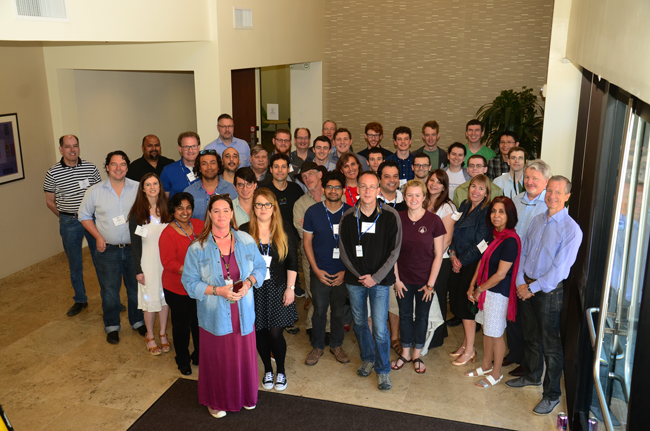
    Participants are set up in five teams consisting of four members:

    Planetary Defense: Long Period Comets
    Provide more warning time for long-period comet impacts by applying deep learning to meteor shower observations

    Planetary Defense: Radar 3D Shape Modeling
    Develop a methodology to automate the backlog of neo radar imagery that requires shape modeling – and also improve the resolution of the result

    Space Resources: Lunar Water & Volatiles
    Determine the location and most promising access points for vital lunar H2O, in terms of cost effectiveness and engineering constraints

    Space Weather: Solar-Terrestrial Interactions
    Improve understanding of solar influence on Earth’s magnetosphere and atmosphere

    Space Weather: Solar Storm Prediction
    Discovering new relationships and agents to help predict major solar events

    A sixth team comprised of undergraduate students will address AI and the space sciences by exploring the application
    of AI as a breakthrough capability for the space program, informed by the experience of FDL and its partner network.
    VIRGO
    VIRGO --- ---
    Teď začínají!

    Tony Darnell / Deep Astronomy - Mercury: Bombarded by many tiny meteoroids

    https://www.pscp.tv/DeepAstronomy/1YpJkmbNmPVKj

    It has been known for a long time that Mercury, the innermost planet in the solar system does not have much of an atmosphere.
    This variable “exosphere” around Mercury has been detected several times and appears to contain numerous interesting chemical
    elements besides hydrogen. Chemicals such as potassium, sodium, oxygen and even water vapor also have been measured. Besides
    that, there also is seasonal variation in the dust/meteoroid environment of Mercury. The material varies with position on the
    planet and sometimes has a dawn–dusk asymmetry. But why? Where is the material in Mercury’s exosphere come from? Is it from
    the surface, or the blast from the Solar wind. A new analysis of comets suggests that these are the orgin of some features
    in Mercury’s exosphere.

    Join Tony Darnell and Carol Christian during Afternoon Astronomy Coffee on July 27, 2017 at 3PM Eastern (Daylight) Time as
    they discuss with Menelaus Sarantos and Diego Janches about their study of this fascinating planet.

    https://www.facebook.com/DeepAstronomy/videos/1434120169986890/
    VIRGO
    VIRGO --- ---
    Half of the Milky Way comes from other galaxies | Science News
    https://www.sciencenews.org/article/half-milky-way-comes-other-galaxies

    Simulations suggest that galactic winds blew the material in from elsewhere

    New simulations suggest that nearly half the matter in the Milky Way may have been siphoned from the gas of other galaxies.
    That gas provides the raw material that galaxies use to build their bulk. The finding, scheduled to appear in the Monthly
    Notices of the Royal Astronomical Society, reveals a new, unexpected way for galaxies to acquire matter and could give
    clues to how they evolve.

    Galaxies trade gas | Science News
    https://www.youtube.com/watch?v=Opq0YATsKX8
    VIRGO
    VIRGO --- ---
    Příběh tří hvězdných měst | ESO Česko
    http://www.eso.org/public/czechrepublic/news/eso1723/?lang

    Díky novým pozorováním, která pořídil dalekohled VST, se astronomům podařilo odhalit tři různé populace mladých stálic tvořících hvězdokupu
    v nitru Velké mlhoviny v souhvězdí Orion. Nečekaný výsledek přináší nový pohled na chápání procesu vzniku hvězdokup. Naznačuje totiž, že ke
    vzniku hvězd mohlo docházet v explozivních etapách, přičemž každá epizoda se odehrála mnohem rychleji, než se dříve myslelo.

    Širokoúhlá kamera OmegaCAM pracující na dalekohledu ESO/VST (VLT Survey Telescope) pořídila nové detailní a působivé záběry Velké mlhoviny
    v Orionu (Orion Nebula) a s ní spojené hvězdokupy mladých hvězd. Tato mlhovina je jednou z nejbližších oblastí s probíhajícím vznikem malých
    i velkých hvězd a nachází se ve vzdálenosti asi 1 350 světelných let od Země.

    Zooming in on the Orion Nebula | ESO Česko
    http://www.eso.org/public/czechrepublic/videos/eso1723b/

    Zooming in on the Orion Nebula
    https://www.youtube.com/watch?v=Rkg5RXxlxuk
    VIRGO
    VIRGO --- ---
    Has Cassini found a universal driver for prebiotic chemistry at Titan? / Cassini-Huygens / Space Science / Our Activities / ESA
    http://www.esa.int/...-Huygens/Has_Cassini_found_a_universal_driver_for_prebiotic_chemistry_at_Titan

    The international Cassini-Huygens mission has made a surprising detection of a molecule that is
    instrumental in the production of complex organics within the hazy atmosphere of Saturn’s moon Titan.

    Titan boasts a thick nitrogen and methane atmosphere with some of the most complex chemistry seen in the Solar System.
    It is even thought to mimic the atmosphere of early Earth, before the build-up of oxygen. As such, Titan can be seen
    as a planet-scale laboratory that can be studied to understand the chemical reactions that may have led to life on Earth,
    and that could be occurring on planets around other stars.

    In Titan’s upper atmosphere, nitrogen and methane are exposed to energy from sunlight and energetic particles in Saturn’s
    magnetosphere. These energy sources drive reactions involving nitrogen, hydrogen and carbon, which lead to more complicated
    prebiotic compounds.

    VIRGO
    VIRGO --- ---
    Using powerful Dark Energy Camera, scientists reach the cosmic dawn | EurekAlert! Science News
    https://www.eurekalert.org/pub_releases/2017-07/asu-upd072617.php

    Arizona State University astronomers Sangeeta Malhotra and James Rhoads, working with international teams in Chile and China,
    have discovered 23 young galaxies, seen as they were 800 million years after the Big Bang. The results from this sample have
    been recently published in the Astrophysical Journal.

    VIRGO
    VIRGO --- ---
    Giant Radio Telescope Scaled Back to Contain Costs - Scientific American
    https://www.scientificamerican.com/article/giant-radio-telescope-scaled-back-to-contain-costs/

    Crowding antennas closer together may affect the Square Kilometer Array's ability to observe the early Universe

    Designs for the world’s largest radio telescope have been scaled back to save money—a decision that astronomers
    say could affect its ability to peer deep into the Universe’s past.

    The Square Kilometre Array (SKA), a telescope 50 times more sensitive than current instruments, is expected to cost
    billions of dollars. Its final design calls for around 2,000 radio dishes in Africa, together with up to one million
    antennas in Australia, that will have a total light-collecting area of roughly 1 square kilometre—hence the project's
    name.

    VIRGO
    VIRGO --- ---
    Galactic David and Goliath | ESA/Hubble
    http://www.spacetelescope.org/news/heic1712/

    The gravitational dance between two galaxies in our local neighbourhood has led to intriguing visual features in both as witnessed in this new
    NASA/ESA Hubble Space Telescope image. The tiny NGC 1510 and its colossal neighbour NGC 1512 are at the beginning of a lengthy merger, a crucial
    process in galaxy evolution. Despite its diminutive size, NGC 1510 has had a significant effect on NGC 1512’s structure and amount of star formation.

    VIRGO
    VIRGO --- ---
    The Making of a Pre-Planetary Nebula
    http://aasnova.org/2017/07/26/the-making-of-a-pre-planetary-nebula/

    The gas expelled by dying stars gets twisted into intricate shapes and patterns as
    nebulae form. Now a team of researchers might have some answers about how this happens.

    VIRGO
    VIRGO --- ---
    Čerstvý DAH s úžasným hostem!!
    Can we really travel to other stars? Can Breakthrough Starshot meet its goals?

    Breakthrough Starshot aims to demonstrate proof of concept for ultra-fast light-driven nano-crafts, and lay the foundations
    for a first launch to Alpha Centauri within the next generation. Along the way, the project could generate important supplementary
    benefits to astronomy, including solar system exploration and detection of Earth-crossing asteroids.

    Join us this week with Dr. Avi Loeb the Chairman of the Breakthrough Starshot Advisory Committee as we discover the new projects
    and initiatives that are paving the way to travel to the nearest exoplanetary systems.

    From the First Star to Milkomeda Kindle Edition - https://www.amazon.com/dp/B014GCTXF0

    Breakthrough Starshot Updates w/ Avi Loeb
    https://www.youtube.com/watch?v=Aja7eH3faOE


    VIRGO
    VIRGO --- ---
    Apollo Asteroid 2017 BS5 just missed the Earth safely at 19:19 UTC at 3.1 times the distance to the
    Moon, at a speed (relative to the Earth) of 5.8 km/s. It is estimated to be 28 - 90 meters in size.

    http://minorplanetcenter.net/db_search/show_object?object_id=2017%20BS5

    https://www.youtube.com/watch?v=mEp0ON2XcJ4
    XCHAOS
    XCHAOS --- ---
    VIRGO: a tady praktický nápad, jak s tím komunikovat:
    SailBeam: A Conversation with Jordin Kare
    https://www.centauri-dreams.org/?p=38164
    VIRGO
    VIRGO --- ---
    VIRGO
    VIRGO --- ---
    Massive star's dying blast caught by rapid-response telescopes
    https://phys.org/news/2017-07-massive-star-dying-blast-caught.html

    In June 2016, an international team of 31 astronomers, led by the University of Maryland's Eleanora Troja and including
    Arizona State University's Nathaniel Butler, caught a massive star as it died in a titanic explosion deep in space.

    The blast of the dying star released in about 40 seconds as much energy as the Sun releases over its entire lifetime,
    all focused into a tight beam of gamma rays aimed by chance toward Earth.

    The team's findings, reported in the scientific journal Nature, provide strong evidence for one of two competing models
    for how gamma-ray bursters (GRBs) produce their energy.

    VIRGO
    VIRGO --- ---
    Comet C2015 ER61 Panstars taken by Salvador Torres Morales on July 26, 2017 @ San Juan, Puerto Rico.

    VIRGO
    VIRGO --- ---
    Reaching for the Stars, Breakthrough Sends Smallest-Ever Satellites into Orbit - Scientific American
    https://www.scientificamerican.com/...-stars-breakthrough-sends-smallest-ever-satellites-into-orbit/

    Despite technical glitches and regulatory hurdles, nanosatellite swarms could someday be the cornerstone for revolutionary
    interplanetary or even interstellar space-science missions.

    VIRGO
    VIRGO --- ---
    Space in Images - 2017 - 06 - Euclid flagship mock galaxy catalogue
    http://www.esa.int/spaceinimages/Images/2017/06/Euclid_flagship_mock_galaxy_catalogue

    ESA’s Euclid mission, to be launched in 2020, is set to provide a unique window into the evolution of our 13.8 billion year-old Universe.
    It will map the history of the Universe’s structure by studying billions of galaxies. In this way, it will be able to probe the nature of
    invisible dark matter, which makes itself known by the forces it exerts on ordinary matter, and the mysterious dark energy that drives
    the accelerating expansion of the Universe.

    VIRGO
    VIRGO --- ---
    Mars rover spots clouds shaped by gravity waves | Science | AAAS
    http://www.sciencemag.org/news/2017/03/mars-rover-spots-clouds-shaped-gravity-waves

    NASA’s Curiosity rover usually keeps its instruments firmly focused on Mars’s ground, zapping grit with its laser or drilling
    cores in bedrock. But every few days, the SUV-sized robot, like any good dreamer, shifts its sights upward to the clouds.

    Well into its fifth year, the rover has now shot more than 500 movies of the clouds above it, including the first ground-based
    view of martian clouds shaped by gravity waves, researchers reported here this week at the Lunar and Planetary Science Conference.
    (Gravity waves, common atmospheric ripples on Earth that result from air trying to regain its vertical balance, should not be
    confused with gravitational waves, cosmological ripples in spacetime.) The shots are the best record made so far of a mysterious
    recurring belt of equatorial clouds known to influence the martian climate.


    VIRGO
    VIRGO --- ---
    Four new short-period giant planets discovered
    https://phys.org/news/2017-07-short-period-giant-planets.html

    Astronomers have detected four new giant exoplanets as part of the Hungarian-made Automated Telescope Network-South (HATSouth) exoplanet survey.
    The newly found alien worlds are about the size of Jupiter, but less massive. They transit moderately bright stars and have short orbital periods.
    The findings were presented July 22 in a paper published on arXiv.org.

    HATSouth is a network of six astrograph telescope systems located in South America, Africa, and Australia. These telescopes are designed to detect
    transiting extrasolar planets in orbit around relatively bright stars visible from the Southern hemisphere. Since its launch in 2009, the network
    has already detected dozens of transiting exoplanets.

    Now, the list of planets detected by HATSouth has expanded. In a recent paper, a team of researchers led by Rafael Brahm of the Pontifical Catholic
    University of Chile in Santiago presents the discovery of four new planets, HATS-43b, HATS-44b, HATS-45b, and HATS-46b. The planetary nature of
    transiting signals detected by HATSouth was confirmed by follow-up spectroscopic and photometric observations using various instruments, including
    the Las Cumbres Observatory Global Telescope (LCOGT) network at the Cerro Tololo International Observatory (CTIO) in Chile.

    This extensive observational campaign that led to the discovery of four new alien worlds was carried out from December 2009 to October 2016.

    VIRGO
    VIRGO --- ---
    To bylo "o fous", a navíc jsme to úplně prospali... :)

    Asteroid *2017 OO1* discovered. It missed the Earth really close (but still safe!) on Jul 21 at 02:27 UT.
    Dist: 0.33 LD (0.32 LD from Earth surface). Size: 25-78 m. Closer report comming.


    IAU Minor Planet Center
    http://www.minorplanetcenter.net/db_search/show_object?object_id=2017+OO1

    A newly discovered asteroid designated 2017 OO1 flew past Earth at a very close distance of 0.33 LD
    (~125 720 km / 78 740 miles) at 02:27 UTC on July 21, 2017. It was discovered 2 days after its closest approach.

    This is the 21st known near-Earth asteroid to flyby Earth within 1 lunar distance since the start of the year.
    The last time one flew past us within that distance was on May 4. Asteroid 2017 OO1 belongs to the Aten group
    of asteroids and was first observed at ATLAS-MLO, Mauna Loa, Hawaii on July 23, 2017.

    Its estimated diameter is between 35 to 77 m (115 - 252.6 feet) and it flew past Earth at a speed (relative to
    the Earth) of 10.36 km/s.

    Asteroid 2017 OO1 flew past Earth at a very close distance of 0.33 LD
    https://watchers.news/2017/07/25/asteroid-2017-oo1/

    VIRGO
    VIRGO --- ---
    https://www.nasa.gov/feature/jpl/large-distant-comets-more-common-than-previously-thought

    Comets that take more than 200 years to make one revolution around the Sun are notoriously difficult to study. Because they spend most of their time far from our area
    of the solar system, many "long-period comets" will never approach the Sun in a person's lifetime. In fact, those that travel inward from the Oort Cloud - a group of
    icy bodies beginning roughly 186 billion miles (300 billion kilometers) away from the Sun - can have periods of thousands or even millions of years.

    NASA's WISE spacecraft, scanning the entire sky at infrared wavelengths, has delivered new insights about these distant wanderers. Scientists found that there are about
    seven times more long-period comets measuring at least 0.6 miles (1 kilometer) across than had been predicted previously. They also found that long-period comets are on
    average up to twice as large as "Jupiter family comets," whose orbits are shaped by Jupiter’s gravity and have periods of less than 20 years.

    VIRGO
    VIRGO --- ---
    https://www.nasa.gov/feature/goddard/2017/chasing-the-total-solar-eclipse-from-nasa-s-wb-57f-jets

    For most viewers, the Aug. 21, 2017, total solar eclipse will last less than two and half minutes. But for one team of NASA-funded
    scientists, the eclipse will last over seven minutes. Their secret? Following the shadow of the Moon in two retrofitted WB-57F jet planes.

    Amir Caspi of the Southwest Research Institute in Boulder, Colorado, and his team will use two of NASA’s WB-57F research jets to chase
    the darkness across America on Aug. 21. Taking observations from twin telescopes mounted on the noses of the planes, Caspi will ­­­­­capture
    the clearest images of the Sun’s outer atmosphere — the corona — to date and the first-ever thermal images of Mercury, revealing how
    temperature varies across the planet’s surface.

    NASA Jets Chase The Total Solar Eclipse
    https://www.youtube.com/watch?v=R0GNqlGNZkI
    VIRGO
    VIRGO --- ---
    A new long period comet has been discovered: Comet C/2017 O1

    http://www.minorplanetcenter.net/db_search/show_object?object_id=C/2017%20O1


    COMET C/2017 O1 taken by Ernesto Guido on July 23, 2017 @ remotely from Australia, Siding Spring.


    New Comet C/2017 O1 ASSSN

    Comet 2017 ASASSN1 (not a formal name yet) imaged by Nidia Morell with the Magellan 6.5-m telescope, image processed by Subo Dong.


    C/2017 O1 ASSSN taken by rolando ligustri on July 22, 2017 @ from Australia SSO, Itelescope.net

    VIRGO
    VIRGO --- ---
    Cassini: The Grand Finale: Cassini's First D-Ring Crossing
    https://saturn.jpl.nasa.gov/resources/7714/?category=videos

    The sounds and colorful spectrogram in this still image and video represent data collected by the Radio and Plasma
    Wave Science, or RPWS, instrument on NASA's Cassini spacecraft, as it crossed through Saturn's D ring on May 28, 2017.

    VIRGO
    VIRGO --- ---
    VIRGO
    VIRGO --- ---
    https://www.nasa.gov/image-feature/jpl/pia21339/ring-bow

    This view looks toward the sunlit side of the rings from about 19 degrees above the ringplane.
    The image was taken in visible light with the Cassini spacecraft wide-angle camera on April 10, 2017.

    The view was obtained at a distance of approximately 1.1 million kilometers from Saturn and at
    a sun-Saturn-spacecraft, or phase, angle of 128 degrees. Image scale is 69 kilometers per pixel.

    VIRGO
    VIRGO --- ---
    Discovery of a rare quadruple gravitational lens candidate with Pan-STARRS
    https://phys.org/news/2017-07-discovery-rare-quadruple-gravitational-lens.html

    Astronomers from the United States Naval Observatory (USNO) in conjunction with colleagues from the University of California, Davis, and
    Rutgers University have discovered the first quadruple gravitational lens candidate within data from the Panoramic Survey Telescope and Rapid

    Response System (Pan-STARRS) using a combination of all-sky survey data from the USNO Robotic Astrometric Telescope (URAT) and the Wide-field
    Infrared Survey Explorer (WISE).

    USNO graduate student George Nelson, who was performing a URAT variability study of the brightest quasars identified by USNO astronomers using
    WISE colors, discovered the lens while investigating the optical properties of a bright quasar sample. The paper describing this serendipitous
    discovery has been accepted for publication in the Astrophysical Journal.

    A preprint of the paper may be found at arxiv.org/abs/1705.08359. A paper confirming the discovery by a separate team of astronomers using the
    Keck Cosmic Web Imager has been submitted to the Astrophysical Journal Letters. A preprint of this paper may be found at arxiv.org/abs/1707.05873.

    VIRGO
    VIRGO --- ---
    Cosmologists produce new maps of dark matter dynamics | UoP News
    http://uopnews.port.ac.uk/2017/07/25/cosmologists-produce-new-maps-of-dark-matter-dynamics/

    New maps of dark matter dynamics in the Universe have been produced by a team of international cosmologists.

    Using advanced computer modelling techniques, the research team has translated the distribution of galaxies into detailed maps of matter
    streams and velocities for the first time. The research was carried out by leading cosmologists from the UK, France and Germany.

    The researchers used legacy survey data obtained during 2000 – 2008 from the Sloan Digital Sky Survey (SDSS), a major three-dimensional
    survey of the Universe. The survey has deep multi-colour images of one fifth of the sky and spectra for more than 900,000 galaxies.

    The new dark matter maps cover the Northern Sky up to a distance of 600 megaparsecs, which is the equivalent of looking back about two
    billion years. The researchers used a set of phase-space analysis tools and built on research from 2015, which reconstructed the initial
    conditions of the nearby Universe.

    VIRGO
    VIRGO --- ---
    Why Cosmic Inflation Is Here To Stay
    http://nautil.us/issue/48/chaos/the-inflated-debate-over-cosmic-inflation

    Why the majority of physicists are on one side of a recent exchange of letters.

    VIRGO
    VIRGO --- ---
    The Story of a Boring Encounter with a Black Hole
    http://aasnova.org/2017/07/24/the-story-of-a-boring-encounter-with-a-black-hole/

    Remember the excitement three years ago before the gas cloud G2’s encounter with the supermassive black hole at the center of our galaxy, Sgr A*?
    Did you notice that not much was said about it after the fact? That’s because not much happened — and a new study suggests that this isn’t surprising.

    G2, an object initially thought to be a gas cloud, was expected to make its closest approach to the 4.6-million-solar-mass Sgr A* in 2014. At the pericenter
    of its orbit, G2 was predicted to pass as close as 36 light-hours from the black hole. This close brush with such a massive black hole was predicted to tear
    G2 apart, causing much of its material to accrete onto Sgr A*. It was thought that this process would temporarily increase the accretion rate onto the black
    hole relative to its normal background accretion rate, causing Sgr A*’s luminosity to increase for a time.

    Instead, Sgr A* showed a distinct lack of fireworks, with very minimal change to its brightness after G2’s closest approach. This “cosmic fizzle” has raised
    questions about the nature of G2: was it really a gas cloud? What else might it have been instead? Now, a team of scientists led by Brian Morsony (University
    of Maryland and University of Wisconsin-Madison) have run a series of simulations of the encounter to try to address these questions.

    Kliknutím sem můžete změnit nastavení reklam