• úvod
  • témata
  • události
  • tržiště
  • diskuze
  • nástěnka
  • přihlásit
    registrace
    ztracené heslo?
    DRAGONFotografie z vesmíru a kosmonautiky +videa
    VIRGO
    VIRGO --- ---
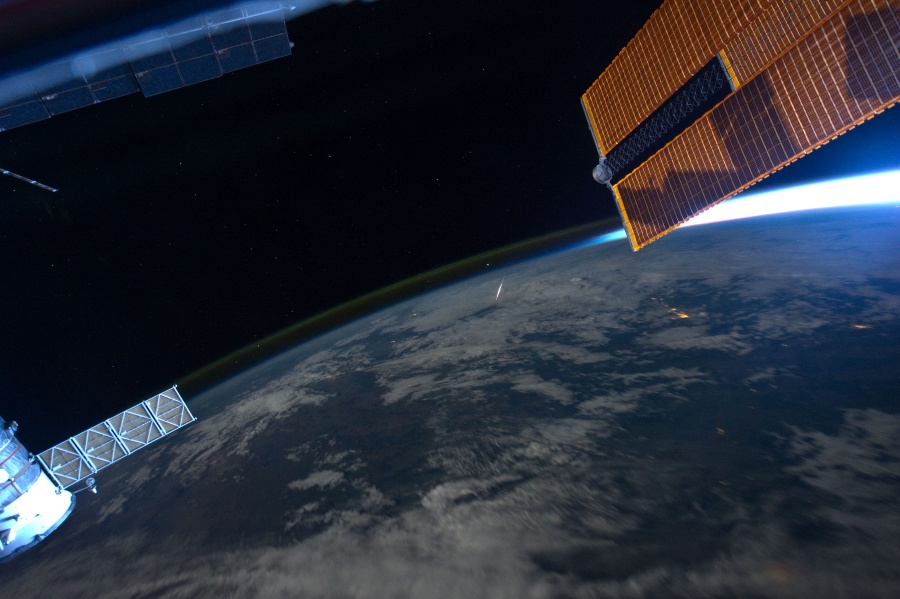
    Despite the Perseid meteor shower being more visible in the northern hemisphere, due to the path of Comet Swift-Tuttle's orbit,
    the shower was also spotted from the exceptionally dark skies over ESO's Paranal Observatory in Chile.


    Denizens of planet Earth watched last year's Perseid meteor shower by looking up into the bright moonlit night sky. But this remarkable view captured
    on August 13, 2011 by astronaut Ron Garan looks down on a Perseid meteor. From Garan's perspective onboard the International Space Station orbiting
    at an altitude of about 380 kilometers, the Perseid meteors streak below, swept up dust left from comet Swift-Tuttle heated to incandescence. The
    glowing comet dust grains are traveling at about 60 kilometers per second through the denser atmosphere around 100 kilometers above Earth's surface.
    In this case, the foreshortened meteor flash is right of frame center, below the curving limb of the Earth and a layer of greenish airglow, just below
    bright star Arcturus. Want to look up at this year's Perseid meteor shower? You're in luck. This weekend the shower should be near its peak, with less
    interference from a waning crescent Moon rising a few hours before the Sun.


    Perseid Meteor Shower Peaks August 12 - Perseid Meteor Shower: Jim Gamble photographed this "nice, bright and
    long magnitude -8.6 Perseid" using an all-sky camera at the El Paso Station of the Sandia All Sky Camera Network.

    HWLLFFRDD
    HWLLFFRDD --- ---


    NASA's Mars Science Laboratory Image

    This imagery is being released in association with NASA's Mars Science Laboratory mission. This is a temporary caption to be replaced as soon as more information is available. Image credit: NASA/JPL-Caltech
    THERIDANE
    THERIDANE --- ---
    (pro změnu ESA, koráb MGS-3)

    BRAMBOROVY_KRAL
    BRAMBOROVY_KRAL --- ---
    HWLLFFRDD: (Mlha to neni, jenom zapraseny pruhledny kryt kamery :)
    TOXICMAN
    TOXICMAN --- ---
    HWLLFFRDD: v kontextu okolní krajiny z 3D modelu

    HWLLFFRDD
    HWLLFFRDD --- ---
    Mlha se hlásí!


    Curiosity's first color image of the Martian landscape looking north
    DACELO
    DACELO --- ---
    LAKSYMO: The Mars Reconnaissance Orbiter snapped a picture of the Curiosity rover about a minute before it landed. Curiosity's parachute is fully deployed.
    LAKSYMO
    LAKSYMO --- ---
    VIRGO
    VIRGO --- ---
    TOXICMAN: JOP! :)
    TOXICMAN
    TOXICMAN --- ---
    HADIAK
    HADIAK --- ---
    LAKSYMO: viac infa tu: [ Dobyvani vesmiru a kosmonautika ]


    TOXICMAN: dik, tak mi to staci.
    LAKSYMO
    LAKSYMO --- ---
    od kolika je ten přenos?
    TOXICMAN
    TOXICMAN --- ---
    HADIAK: mám za to, že fotka, ale nemůžu to přesně dohledat
    HADIAK
    HADIAK --- ---
    a to je fotka abo render?
    VIRGO
    VIRGO --- ---
    TOXICMAN: jeste se jednou vyspim!! (pac v nedeli asi nepujdu spat...:D)
    TOXICMAN
    TOXICMAN --- ---
    DRAGON
    DRAGON --- ---
    TOXICMAN: skvely, zrovna sem si rikal ze si udelam novej wallpaper ;) nemas to nahodou v rozlisenim minimalne 2560x1440 pripadne tam kde si to nasel? dik
    TOXICMAN
    TOXICMAN --- ---
    soon
    TOXICMAN
    TOXICMAN --- ---
    VIRGO
    VIRGO --- ---
    TOXICMAN
    TOXICMAN --- ---
    TOXICMAN
    TOXICMAN --- ---
    HWLLFFRDD
    HWLLFFRDD --- ---


    Saturn's Moons

    The Cassini spacecraft watches a pair of Saturn's moons, showing the hazy orb of giant Titan beyond smaller Tethys. This view looks toward the Saturn-facing sides of Titan (3,200 miles, or 5,150 kilometers across) and Tethys (660 miles, or 1,062 kilometers across).

    The image was taken in visible green light with the Cassini spacecraft narrow-angle camera on Oct. 18, 2010. The view was obtained at a distance of approximately 1.6 million miles (2.5 million kilometers) from Titan and at a Sun-Titan-spacecraft, or phase, angle of 55 degrees. The view was obtained at a distance of approximately 930,000 miles (1.5 million kilometers) from Tethys and at a Sun-Tethys-spacecraft, or phase, angle of 55 degrees. Image scale is 15 kilometers (9 miles) per pixel on Titan and 6 miles (9 kilometers) per pixel on Tethys.

    Image Credit: NASA/JPL/Space Science Institute
    VIRGO
    VIRGO --- ---
    VIRGO
    VIRGO --- ---
    MAGNETIC BRIDGE: Sunspots AR1528 and AR1529 appear to be far apart. More than 200,000 km of stellar surface separate the two.
    Nevertheless, they are connected by a tubular bridge of magnetism. NASA's Solar Dynamics Observatory (SDO) photographed the
    vast structure on July 24th. This extreme ultraviolet image traces the bridge via the glow of hot plasma it contains. Material
    can flow back and forth inside the tube, allowing one sunspot to respond to what the other is doing.


    LAKSYMO
    LAKSYMO --- ---
    DILDOO007:
    TANTRAMAN: si ho dali vychladit .))
    THERIDANE
    THERIDANE --- ---
    View from the ISS at Night
    https://vimeo.com/45878034
    TOXICMAN
    TOXICMAN --- ---
    The famous "Earthrise" photo was duplicated this day, July 20th, 1969, by Apollo 11 astronauts shortly before humans set foot on the moon for the first time. The original was taken December 24, 1968, by Apollo 8 astronauts as we orbited the moon for the first time.

    DRAGON
    DRAGON --- ---
    jestli budu nucenej zitra pit Kozla, tak potěš neděle :)
    TANTRAMAN
    TANTRAMAN --- ---
    NYIBELUNGER: zeme kde dnes je jiz zitra.
    Kliknutím sem můžete změnit nastavení reklam